About the Journal
The International Journal of Disaster Studies and Climate Resilience (IJDSCR) (Online ISSN:3107-605X) is a 'Multidisciplinary Subjects' open-access, online-only, no-APC, biannual (June & December) peer-reviewed English-language journal published by Resilience Press, T.C.9/315, 'Anakkathil', Jawahar Nagar, Thiruvananthapuram 695 003, India. DOI is assigned by Crossref. Launched in 2025, IJDSCR provides a scholarly forum for cutting-edge, interdisciplinary work that advances understanding and practice at the intersection of disaster risk reduction, emergency management, and climate-change resilience across the natural, technical and social sciences. The journal website and its contents are OAI-PMH compliant.
IJDSCR metadata is discoverable through Crossref, OpenAlex and ROAD. The Google Citations page of the journal is here
IJDSCR is overseen by a globally diverse Editorial Board drawn from institutions such as IIT Roorkee, Johns Hopkins University, Stuttgart University of Applied Sciences, the National Institute of Disaster Management (India) and many others, ensuring robust disciplinary coverage and a rigorous peer review process.
The journal welcomes original research papers, review articles, case studies, technical notes and short communications on:
disaster risk assessment, mitigation and recovery; climate-change adaptation and resilience planning; nature-based and ecosystem approaches; technological and data-driven innovations (GIS, remote sensing, AI, participatory mapping); policy, governance and socio-economic dimensions of risk; and humanitarian action, health emergencies and community-centred resilience, besides other disaster- and climate change-related themes.
Digital Preservation and Archiving
The International Journal of Disaster Studies and Climate Resilience (IJDSCR) participates in the Public Knowledge Project Preservation Network (PKP PN), a distributed digital preservation network based on LOCKSS technology. Published journal content is regularly deposited in the PKP PN to ensure its long-term preservation and continued availability in the event that the journal or publisher website becomes unavailable. The journal's preservation status is independently recorded through the Keepers Registry associated with the ISSN International Centre.
Copyright Policy: All articles are published under the copyright policy is CC BY 4.0 (Creative Commons Attribution 4.0 International); authors retain copyright and may self-archive the accepted or published version immediately. They retain full publishing rights without restrictions. By fostering open, inclusive knowledge exchange, IJDSCR strives to bridge research, policy and practice, supporting vulnerable communities in a rapidly changing climate. The journal is granted the right of first publication.
Licensing transition: IJDSCR adopted the Creative Commons Attribution 4.0 International Licence (CC BY 4.0) for articles published from 29 April 2026, beginning with DOI 10.64866/j.ijdscr.2026.10028. Articles published before this date retain their original Creative Commons Attribution-ShareAlike 4.0 International Licence (CC BY-SA 4.0). The applicable licence is displayed on each article page and in the published PDF.
Publisher’s Note: IJDSCR and Resilience Press remain neutral with regard to jurisdictional claims in published maps, territorial boundaries, place names, and institutional affiliations. The designation of countries, territories, institutions, organizations, and affiliations in published articles is solely for identification and scholarly attribution, and does not imply endorsement, recognition, or approval by the journal, editors, editorial board, or publisher. Authors are responsible for ensuring that maps, geographic names, institutional names, affiliations, and addresses are accurate, current, and compliant with applicable laws, institutional requirements, and source-data permissions.
Open Access Policy: IJDSCR is a fully open access journal. All articles are freely available immediately upon publication, without subscription, registration, or embargo. Users may read, download, copy, distribute, print, search, link to the full texts, crawl them for indexing, and use them for lawful purposes under the stated Creative Commons licence.
Peer Review Policy: The International Journal of Disaster Studies and Climate Resilience will undertake rigorous, equitable, and timely peer-review process marked by fair editorial decisions, transparency (clear criteria, and timelines) and accountability by adherence to the Committee on Publication Ethics (COPE) Core Practices. Single-blind review, two independent reviewers are normally invited for every article. Additional reviewers may be added at the editors’ discretion (e.g., in highly interdisciplinary submissions or when initial reports conflict). Editors will give weightage for disciplinary expertise, geographic diversity, and gender balance in reviewer selection.
Reviewer Responsibilities: Reviewers must maintain confidentiality, be objective and constructive (by providing evidence-based feedback aimed at improving the work). Must decline if conflict of interest is involved (financial, academic, personal). Reviewers may not upload any part of the manuscript to public AI tools. If AI is used e.g., language checking, reviewers must disclose such use to the editor. Most importantly, notify the editor immediately if unable to meet the agreed deadline.
Appeals and Complaints: Appeals on rejection of ms must be filed within 10 days of the decision, include detailed justification, and will be assessed by an uninvolved Editor. Post-publication ethics. IJDSCR follows COPE flowcharts for corrections, expressions of concern, or retractions. Correction (erratum / corrigendum). Factual or typographical errors that do not invalidate the main findings (e.g., mislabeled figure, minor data slip). Expression of Concern. Credible doubt about reliability but investigation is incomplete and institution still enquiring, evidence inconclusive, authors non-responsive. Retraction. Clear evidence that results are unreliable through error, research misconduct, duplicate publication, plagiarism, or unethical research.
Author Responsibilities
Submit original and unpublished work, properly citing all sources. Secure permission for any third-party copyrighted material. Disclose prior conference papers, preprints, or theses that overlap with the submission. Acknowledge AI tools used in manuscript preparation. Obtain co-author approval for the final manuscript and its ethical compliance statements. Use affiliations that the author deems most fit for the submission.
Submission word limits

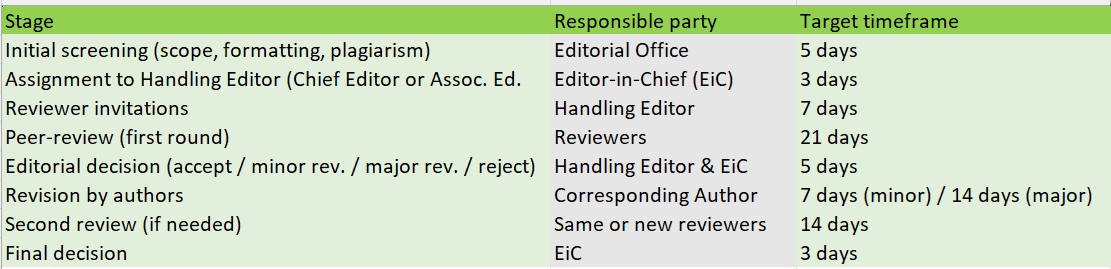
Submission to acceptance timeline: